California Management Review
California Management Review is a premier professional management journal for practitioners published at UC Berkeley Haas School of Business.

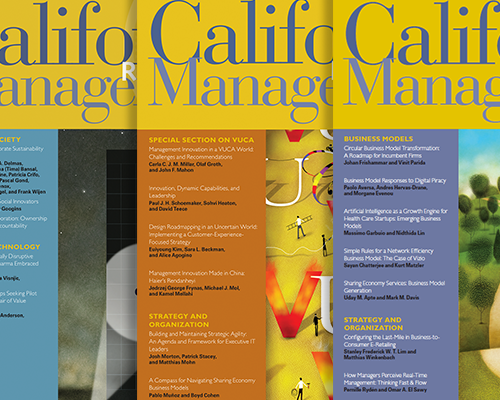
Our fall issue features contributions on digital transformation, social innovation, board governance, and partnerships
A new kind of practitioner-focused research designed to complement our traditional In-Depth articles

 Insight
10 Jan 2019
Nikolas Jintri
Insight
10 Jan 2019
Nikolas Jintri
 Insight
05 Oct 2018
Nikolas Jintri
Insight
05 Oct 2018
Nikolas Jintri
 Insight
01 Oct 2018
Kimberly Rotter
Insight
01 Oct 2018
Kimberly Rotter
 Insight
24 Sep 2018
Marina Arshavskiy
Insight
24 Sep 2018
Marina Arshavskiy
 Insight
07 Sep 2018
Robert Springer
Insight
07 Sep 2018
Robert Springer
 Insight
29 Aug 2018
Nikolas Jintri
Insight
29 Aug 2018
Nikolas Jintri
 Insight
24 Aug 2018
Insight
24 Aug 2018
 Insight
10 Aug 2018
Tom Lyon
Insight
10 Aug 2018
Tom Lyon
 Insight
03 Aug 2018
David Vogel
Insight
03 Aug 2018
David Vogel